
- Aquatic parasite burrows into human skin
- May cause a rash and/or itching
- Parasite is not viable in human host, most likely only hours
- Primary carriers in Higgins Lake are Merganser ducks
- The Stagnicola Snails are essential to complete the parasites life cycle.
- FAQ – Swimmer’s Itch Solutions
Swimmer’s itch (cercarial dermatitis) in Higgins Lake is caused by an allergic reaction to a microscopic parasite that infect Common mergansers and Stagnicola snails. The parasite is released from infected snails into the water looking for the preferred host, common mergansers. If the parasite comes into contact with a swimmer, it burrows into the skin and may cause an allergic reaction and itchy rash.
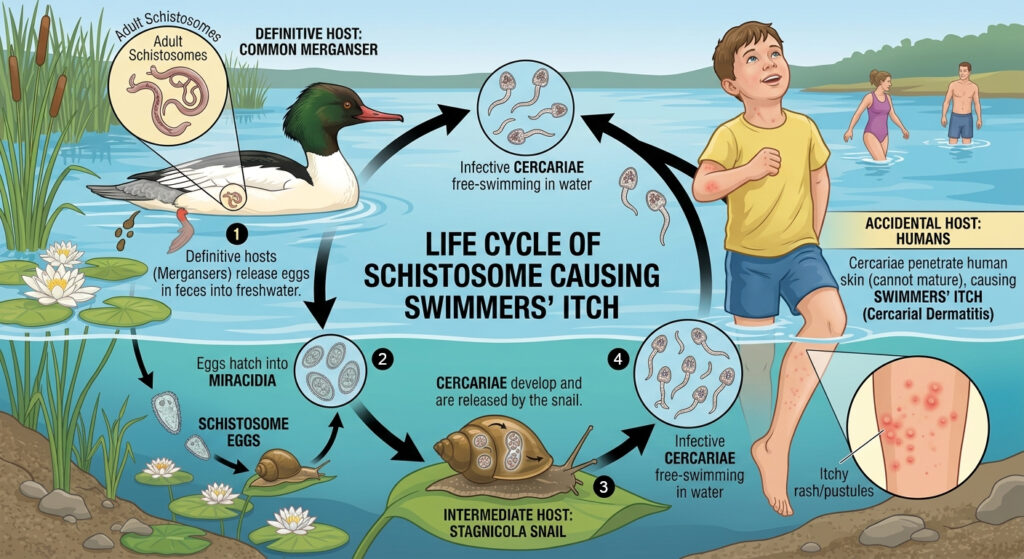
How Swimmer’s Itch Develops
- Swimmer’s itch at Higgins Lake (other lakes may differ) is caused by a microscopic parasite that has a natural life cycle involving merganser ducks and Stagnicola snails. Understanding this cycle helps explain why relocating merganser hens and their ducklings can be an effective way to reduce swimmer’s itch.
- The Swimmer’s Itch Cycle
- The cycle begins when merganser ducks, particularly young ducklings, become infected with the parasite. Infected ducks release parasite eggs into the water through their feces.
- Those eggs eventually develop into microscopic organisms that infect Stagnicola snails living in the lake.
- Once infected, the snails produce and release another stage of the parasite called cercariae. These microscopic organisms leave the snails and enter the water, where they normally seek out another suitable duck host to continue the parasite’s life cycle.
- Humans are an accidental host. When cercariae encounter a person in the water, they can penetrate the skin while attempting to infect what they mistakenly identify as an appropriate host. They cannot survive and reproduce in humans, but their penetration can trigger the skin reaction known as Swimmer’s itch.
- Not everyone reacts to the parasite in the same way. Some people experience little or no reaction, while others develop the characteristic itchy rash associated with swimmer’s itch. Repeated exposure can also cause stronger reactions in some individuals.